
Civil engineering companies in Uganda design and build the structures and infrastructure that buildings and communities depend on: foundations, structural frames, roads, drainage, retaining walls and earthworks. This page explains what civil engineering covers, how it relates to building construction, and what to ask before you hire a company.
We are a URSB-registered construction company in Kampala, and our founders bring 20+ years of construction experience. We work on site preparation, foundations and structural work as part of building projects. For larger civil works, tell us what you need and we will discuss it.
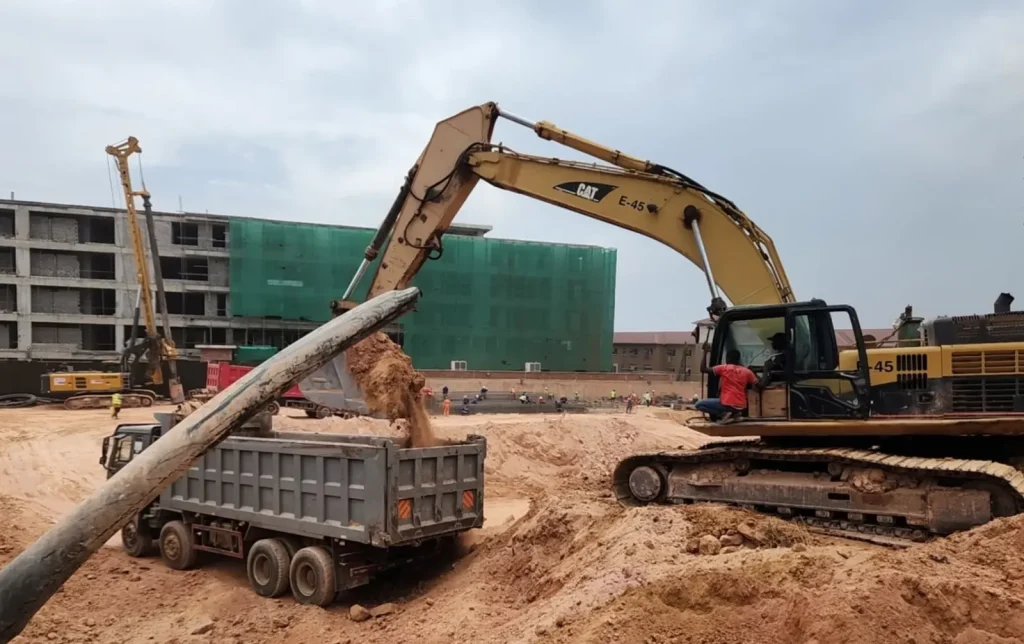
What civil engineering covers
- Earthworks. Clearing, cutting, filling, levelling and hauling soil. See general contracting.
- Foundations. Strip footings, pad footings, raft slabs and piles, designed for the soil and the load.
- Structures. Reinforced concrete frames, retaining walls, culverts and bridges.
- Roads and paving. Access roads, parking areas and drainage.
- Drainage and water. Storm water drains, culverts and site drainage.
Civil engineering and building construction
The two overlap. Before a building rises, civil work prepares the site and builds the foundation. After it, civil work provides the access, drainage and paving. A storeyed house or a factory needs a structural engineer to design the frame, and the quality of the foundation and the concrete decides how long the building lasts.
For buildings, see commercial construction and industrial construction.
What the work looks like on a large site
Our projects include photos of bored pile foundations and earthworks on a large site: excavation and rock breaking, steel reinforcement cages, rotary piling and concrete placed by truck mixer. Large foundations like these need engineering design, careful inspection and good records.
What to check before you hire
- Registration. Ask for the certificate of incorporation and confirm it with URSB.
- Engineers. Ask who the responsible engineer is and whether they are registered to practise.
- Similar work. Ask to see completed work of the same kind and size.
- Design responsibility. Agree who designs, who checks and who signs off the work.
- Testing. For concrete and soil, ask what testing is included and who pays for it.
- Contract and BOQ. Insist on a priced BOQ and a written contract with payment stages.
Read how to choose a construction company for the full checklist.
Related services
This is one of our construction services in Uganda. See construction management for supervision, general contracting for managing the whole project, and building contractors in Uganda for hiring a contractor.
Frequently asked questions
What is the difference between civil engineering and construction?
Construction is the wider act of building. Civil engineering is the discipline of designing and building structures and infrastructure, such as foundations, frames, roads and drainage.
Do I need a structural engineer for a house?
For a storeyed house, yes. The structural engineer designs the frame and the foundation, and the design is submitted with the plans.
Do you build roads?
Tell us what the road or paving work is, how big it is and where. We will discuss what is possible.
Why do foundations differ between sites?
The soil, the water table and the load decide the type of foundation. Poor soil may need piles or a raft slab.
Where do you work?
We are based in Kampala and work across Uganda. Tell us where your site is when you request a quote.