
Part of our guide to Construction Companies in Uganda
To build a house in Uganda, you secure the land, get drawings from an architect and an engineer, have the plans approved, price the work in a bill of quantities, choose a contractor under a written contract, and then build in stages, from the foundation to the finishes. This guide walks through each step in order.
It is written from the builder’s side, by a Kampala construction company whose founders bring 20+ years of experience: the decisions we see owners get right, and the ones that cause delays and extra cost. For our own service, see house construction.
Step 1: Secure the land
Before you spend on design, make sure the land is yours to build on. Check the title, confirm the boundaries and the access, and find out whether the plot is in a wetland, road reserve or other restricted area. A visit by a surveyor is cheap compared with building on the wrong land.
Step 2: Set the brief and the budget range
Decide how many bedrooms and floors you need, the finishes you expect and the money you have. A realistic budget shapes the design. Read the cost of building a house in Uganda to see what drives the cost.
Step 3: Get the drawings
An architect prepares the architectural drawings, and a structural engineer designs the structure of a storeyed house. Good drawings make everything after them easier: approval, pricing and building.
Step 4: Get the plans approved
Plans go to the approving authority: KCCA inside Kampala, or the municipal or district council elsewhere. Do not start building before approval. Building without it can lead to fines, a stop order or demolition. See building permits in Uganda and building plan approval.
Step 5: Price the work in a BOQ
A bill of quantities lists each item of work with its quantity and rate. Ask two or three contractors to price the same drawings and compare the BOQs line by line. Read the bill of quantities guide.
Step 6: Choose the builder and sign a contract
Check the registration, visit finished work, meet the site manager, and agree the scope, the price, the payment stages and the programme in writing. Our guide on how to choose a construction company gives the full checklist.
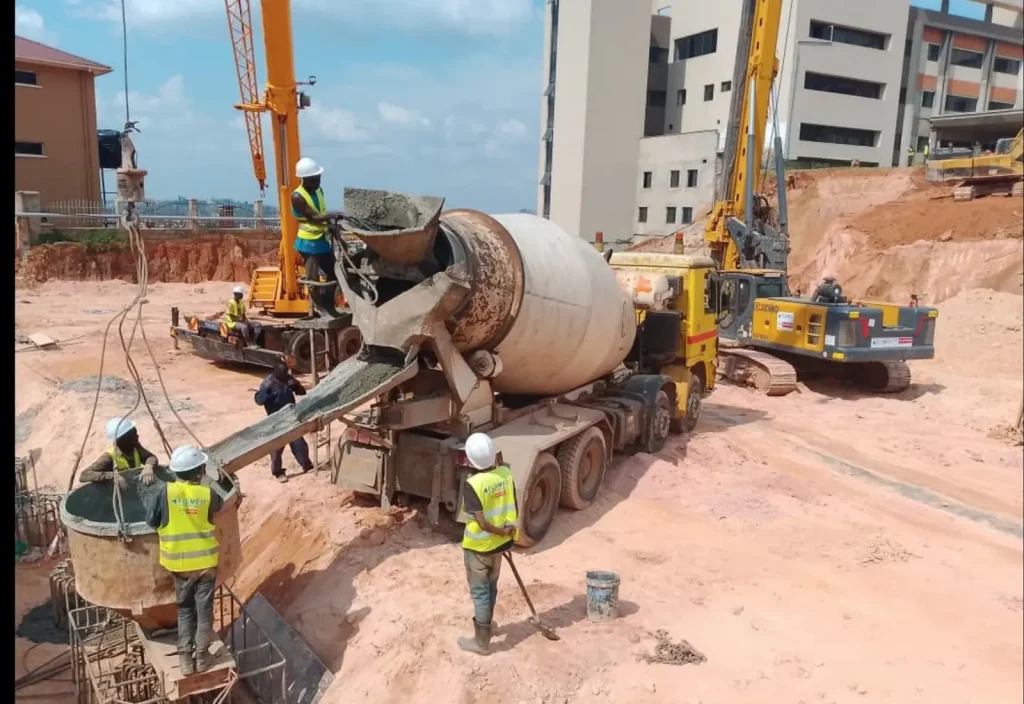
Step 7: Build in stages
Most houses follow the same order.
- Site preparation. Clearing, setting out and excavation.
- Foundation. Footings or piles, and the ground slab.
- Superstructure. Columns, beams, walls and any upper floors.
- Roof. Trusses and the covering. The house is weathertight once the roof is on and the openings are closed.
- Services. Electrical conduits and plumbing, most of which go in before plastering.
- Finishes. Plastering, floors, ceilings, painting, doors, fittings and external works.
- Handover. A walk-through with the builder, a list of defects to fix, and the keys.
See the construction process in Uganda for what happens at each stage and what to inspect.
Step 8: Inspect and pay as you go
Visit the site often. Check each stage against the drawings before you pay for it. Pay for completed work, and keep every receipt and every change in writing.
Common mistakes
- Starting to build before the plans are approved.
- Choosing a builder on price alone.
- Signing without a written contract or a BOQ.
- Changing the design mid-build without agreeing the cost.
- Paying most of the money before the work is done.
Frequently asked questions
How long does it take to build a house in Uganda?
A bungalow takes several months and a storeyed house longer. The size, the weather, the funding and the approvals all matter. Ask for a programme in the contract.
Can I build before the plans are approved?
You should not. Building without approval can lead to fines, a stop order or demolition.
Do I need an architect and an engineer?
You need approved drawings. An architect prepares them, and a structural engineer designs the structure of a storeyed house.
Should I buy the materials myself?
It is your choice. Buying them gives you control of the quality but makes you responsible for purchasing and storage. A labour-and-materials contract puts both with one company.
What should I check before paying the builder?
That the stage you are paying for is complete and matches the drawings, and that the payment is the one set out in the contract.